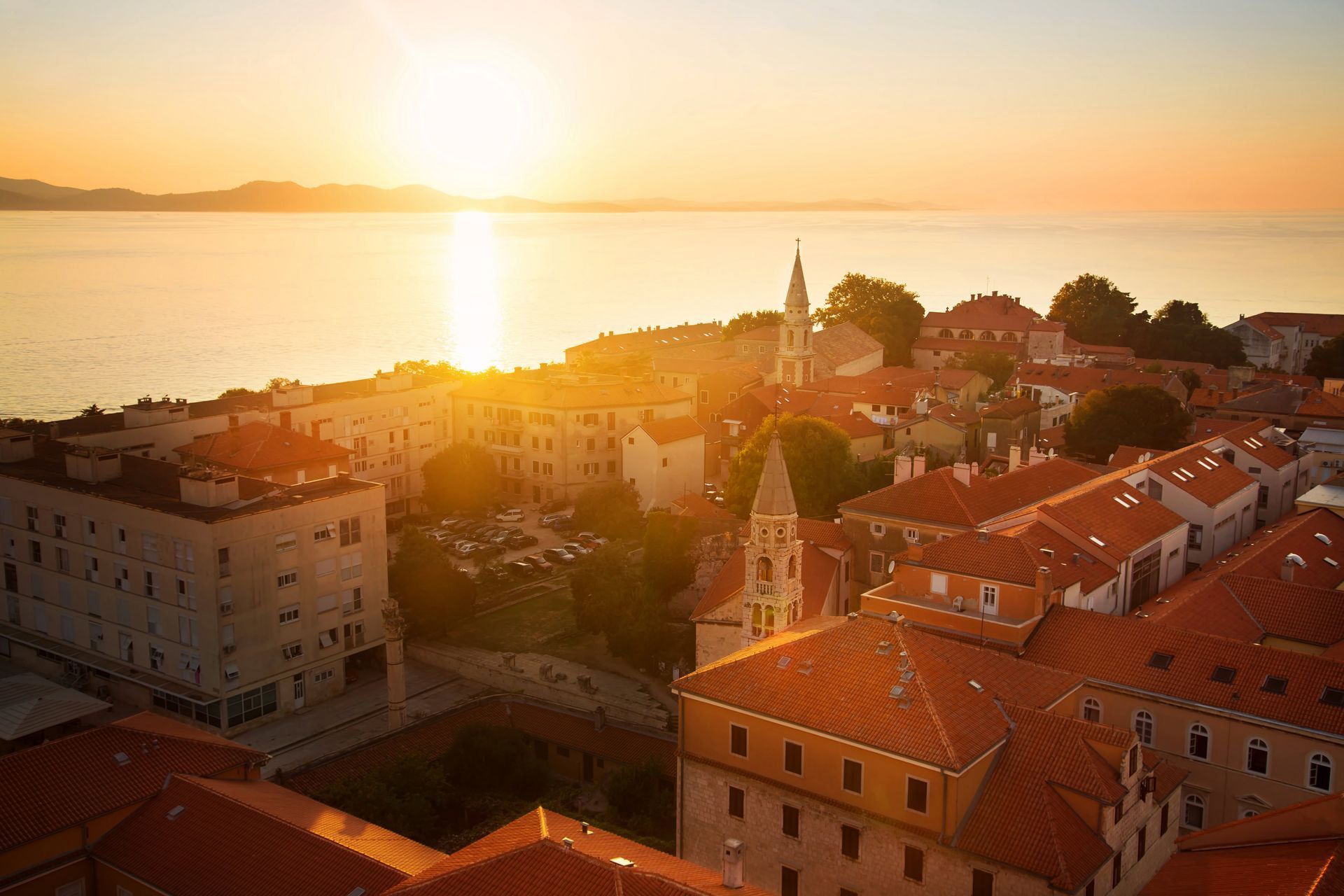
Historic Zadar reveals its character beyond the famous waterfront and monumental Roman Forum. Inside the Old Town, narrow stone lanes open unexpectedly into intimate squares, shaded courtyards, and quiet corners shaped by centuries of Mediterranean life. The compact city centre is best explored slowly, allowing time to notice weathered façades, fragments of ancient walls, and details above former workshops and traditional houses.
Varoš and the lanes around Stomorica Street
Varoš is one of the most atmospheric parts of the city. Beginning near the pedestrian crossroads known as Četiri kantuna, the quarter spreads through Varoška, Kovačka, and Stomorica streets. Its network of Dalmatian kalete, small courtyards, and stone passages preserves the scale of an older, more intimate Zadar.
The present neighbourhood developed during Venetian rule, when people living outside the defensive walls moved into the protected area of the Peninsula. For centuries, Varoš was associated with labourers, craftspeople, modest homes, and small taverns. Former workshops and storage rooms have since become restaurants and cafés, but the district still feels connected to everyday local history.
Stomorica Street is particularly appealing in the early morning, before the terraces become busy. Stone steps, closely spaced buildings, and glimpses into hidden atriums create a setting that rewards unplanned wandering. Rather than following a fixed route, choose whichever passage looks most inviting.
Three Wells Square and Kampo Kaštelo
At the western end of the Old Town lies Kampo Kaštelo, a historic residential quarter close to the Roman Forum, the Cathedral of St. Anastasia, and the Church of St. Donatus. Although surrounded by major landmarks, its side streets are often noticeably quieter than Kalelarga.
The neighbourhood leads towards Three Wells Square, a peaceful place beside the Church of Our Lady of Health and its small green park. The wells recall the importance of reliable water supplies when Zadar was a fortified city. The square’s combination of trees, stone architecture, and open sky makes it an attractive pause between the waterfront and the ecclesiastical heart of Zadar.
Nearby lanes contain a mixture of historic houses and carefully restored heritage buildings. Their uneven stone surfaces and restrained façades are especially beautiful in the late afternoon, when the warm light softens the entire area.
Emperor Augustus Passage
Emperor Augustus Passage, or Prolaz cara Augusta, is easy to miss despite its remarkable historical layers. Near the Captain’s Tower, the passage contains traces associated with Roman and medieval fortifications, as well as later defensive construction. Few places demonstrate the city’s continuous development so clearly within such a compact space.
This is not a grand boulevard lined with shops. Its appeal comes from proximity: ancient masonry, narrow walls, and architectural fragments can be examined at walking pace. The passage also provides a quieter transition towards Five Wells Square and the southern edge of the Peninsula.
Five Wells Square after the daytime crowds
Five Wells Square is among Zadar’s best-known historic spaces, yet its atmosphere changes completely outside the busiest hours. Constructed in 1574, during the threat of an Ottoman siege, the square was built above a large drinking-water cistern. Its five decorated wellheads remain aligned beneath the Captain’s Tower, framed by medieval walls and the entrance to Queen Jelena Madije Park.
Visit shortly after sunrise or during the evening to appreciate the square’s proportions without large groups. From here, climbing into the park provides a different perspective over the defensive structures and the nearby Foša harbour.
Petar Zoranić Square and the city beneath the city
Petar Zoranić Square is a lively gathering place, but its most fascinating feature lies below eye level. Archaeological remains visible beneath glass panels mark the location of an ancient city gate and reveal fragments from several periods of Zadar’s development. The surrounding sixteenth-century bastion and Proveditor’s Palace add further layers to the setting.
The square connects several lanes, making it a natural crossroads rather than an isolated monument. Passing through at different times of day shows how historic public space remains part of contemporary city life.
Beyond Kalelarga
Kalelarga follows the line of the Roman Decumanus Maximus and remains the best-known street in Zadar. However, its greatest value for curious walkers may be the access it provides to smaller parallel routes and side passages.
Turn away from the main flow whenever an archway, stone staircase, or narrow alley catches your attention. Around the Forum, Varoš, and Kampo Kaštelo, even a short detour can reveal a secluded courtyard, an old house entrance, or a tiny square where residents still stop to talk. As evening settles over the Peninsula, these quieter spaces capture the enduring rhythm of Zadar more intimately than any single landmark.